
Are Thermal Breaks Worth It? A Cost and Comfort Breakdown
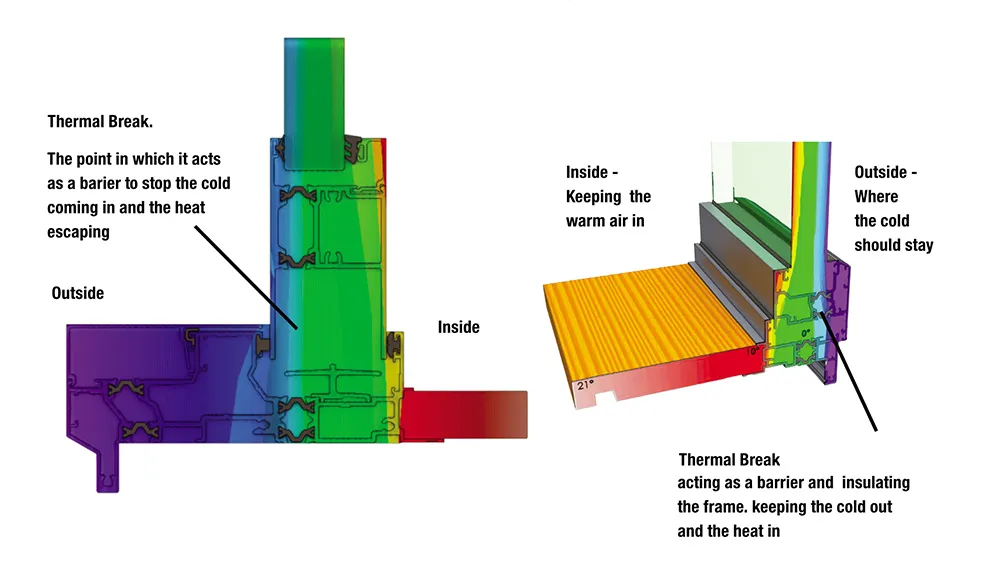
Aluminum conducts heat roughly a thousand times better than the insulating materials we put inside a wall. A frame made of a single aluminum profile therefore behaves like a radiator fin: warm on one side, cold on the other, and condensing in between. A thermal break interrupts that path by inserting a non-conductive section, usually polyamide or polyurethane, between the exterior and interior chambers.
What it changes in measurable terms
The metric is U-factor, the rate of heat flow through the whole assembly per unit area and temperature difference. A thermally broken aluminum frame typically brings frame U-factor into the range where the glass is no longer the only thing doing the work. It does not make the window insulating on its own; it stops the frame from short-circuiting the glass you paid for.
The four effects occupants notice
- Lower heating and cooling load. Reduced conduction at the frame edge shows up in run hours, most clearly in cold-climate heating and in high-solar-gain cooling climates.
- No cold spots. The interior frame surface stays closer to room temperature, which removes the downdraft that makes people close a door to a room they just heated.
- Less condensation. Condensation forms where a surface drops below the dew point. Raising the frame surface temperature is the direct fix, and it matters most in humid climates and in kitchens and bathrooms.
- Some acoustic benefit. The break interrupts a structural path for vibration, so it helps, but it is a secondary effect compared with laminated glass and good seals.
When it is not worth the money
There are honest cases against. In a mild climate with low conditioning hours, the energy saving may never repay the premium, and a well-detailed non-thermal frame with good glazing is the rational choice. For interior partitions, decorative screens and covered outdoor structures, the break buys nothing. And a thermal break cannot compensate for a bad installation: if the perimeter is unsealed, the frame detail is irrelevant.
The premium itself is smaller than most buyers assume. Within the cost of a finished window, moving from a non-thermal to a thermal break profile adds a defined per-ton increment, which on typical residential unit sizes works out to low single-digit percentage points of unit cost. It is one of the cheapest performance upgrades available in the assembly.
What to check in the specification
- Strip material. Polyamide 66 with 25 percent glass fiber is the standard for structural thermal breaks. PVC strips are cheaper, creep under load and lose performance at temperature. If the spec does not name the material, ask.
- Break width. Wider breaks perform better up to the point where structural deflection governs. Ask for the width in millimeters, not for the word enhanced.
- Construction method. Strip-through and pour-and-debridge are both legitimate; what matters is that the break is continuous around the frame and not interrupted at corners and hardware penetrations.
- Test evidence. Ask for the U-factor of the complete assembly from an accredited laboratory, with the report number. Calculated values from a supplier's own spreadsheet are not equivalent.
A simple payback check
You do not need an energy model to make this decision. Take the incremental cost of the thermal break across the whole opening schedule, estimate annual heating and cooling spend attributable to fenestration, and assume a realistic 10 to 20 percent reduction in that share. If the payback lands inside your holding period, specify it. If it lands beyond it, you are buying comfort and condensation control rather than energy savings, and that is a legitimate reason too, as long as you know which one you are buying.
If you want the incremental cost of a thermally broken system against your current specification, send the opening schedule and we will price both versions side by side.
Need this checked against your project?
Send us your drawings or the code requirement — our engineers reply within 12 hours.