
How Thermal Break Window Costs Are Actually Calculated
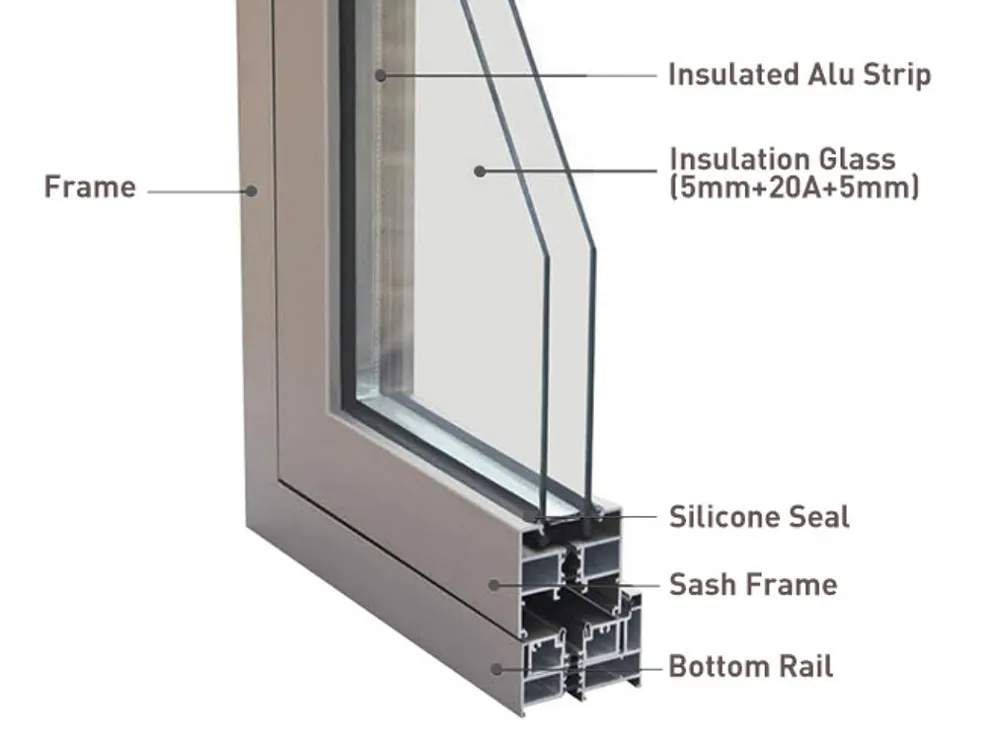
When a buyer asks what a thermal break window costs per square meter, the number they get back is almost meaningless without the build-up. Two quotes at the same price can differ by 30 percent in material content. Understanding the stack is how you compare them honestly, and how you cut cost without cutting performance.
The cost stack
Across the aluminum window and door work we produce, material cost splits roughly as follows. These are structural shares, not prices, so they hold across markets:
- Aluminum profiles: 30 to 40 percent of unit cost
- Glass: 15 to 20 percent
- Hardware: 8 to 10 percent
- The remainder: seals, accessories, fabrication, assembly, testing, packing and inland transport
Everything else in this article is an elaboration of those four lines.
Profiles: ingot plus conversion
Profile cost is the aluminum ingot price plus a conversion fee. The ingot portion tracks the A00 spot market and is usually handled by a locked reference date and a tolerance band, commonly plus or minus 10 percent before adjustment. At roughly 10 kg of aluminum per square meter of window, a 10 percent ingot move is on the order of 2 percent of the finished unit price. It feels volatile in the news and it is small on the invoice.
Conversion covers extrusion, anodizing or coating, packing and inland freight, and it is where supplier differences show up. A second-tier extruder can sit 8 percent under a first-tier one, which translates to under 1 percent of the finished window. Surface treatment drives more: anodizing, powder coating, electrophoretic coating and fluorocarbon finish escalate in that order, and every additional micron of anodic film costs money on a per-ton basis.
The thermal break itself is a defined premium. A strip-through or pour-and-debate thermal break system adds roughly 2,500 RMB per ton over a non-thermal-break profile, and imported polyamide strips add about 2,000 RMB per ton on top. On a 1,500 by 1,500 mm window that second increment works out to under 20 RMB per square meter of window area, and less again when expressed per square meter of floor area. This is the least expensive performance upgrade in the entire assembly, which is why specifying imported strips is rarely the wrong call.
Glass: where the money hides
Glass is raw sheet plus fabrication plus freight. First-tier float brands run about 10 percent above second-tier, and since glass is roughly a fifth of unit cost, that is a 2 percent swing. Fabrication location matters more than brand in many projects: if the insulating glass unit is built near the project, freight approaches zero; if it is built 1,500 km away, 5 mm glass freight alone can run 1 to 10 RMB per square meter and scales with thickness.
The upgrade that pays for itself is Low-E. The cost delta between Low-E and ordinary clear glass runs around 60 RMB per square meter of glass, which is roughly 10 RMB per square meter of floor area at typical window-to-floor ratios. If the project can sell the efficiency or the comfort, that 10 RMB often supports a 50 to 100 RMB per square meter improvement in sale price. Run that arithmetic before deleting the coating to hit a budget.
Hardware: small share, large failure cost
Hardware is 8 to 10 percent of unit cost, so a 15 percent brand premium moves the total by about 1.5 percent. It is also the component most likely to generate a callback. Two rules are worth writing into the specification: nominal load rating at least 1.5 times the actual sash weight, and operating cycles of 100,000 or more for moving hardware, which is the class A threshold. Stainless steel costs more than zinc alloy, which costs more than aluminum alloy; for coastal projects the stainless requirement is not optional.
Design decisions that move price more than material
- Sash count. Every operable sash adds hardware, labor and a leak path. The cheapest high-performance window is a large fixed light with a small operable panel beside it.
- Unit size. Glass over 1.5 square meters in a single pane must be tempered in most codes, which adds more than 20 percent to that glass cost. Splitting a large opening into two units is often cheaper than one oversized pane.
- Transom height. A head transom under 400 mm is disproportionately expensive to build and almost impossible to clean. Delete it or raise it.
- Opening type. Sliding units cost less than swing units at the same performance level, and fixed units cost least. The old rule still holds: more fixed, fewer operable, more sliding, fewer casements.
- Performance target. Chasing a U-factor below what the code requires is a real cost, since it forces better spacers, wider cavities and sometimes triple glazing. Set the target from the code and the client's operating cost, not from a competitor's brochure.
How to read the quote you were sent
Ask for these five things and the comparison becomes possible: profile series and wall thickness; thermal break type and strip origin; glass make-up written as thickness-cavity-thickness with coating, gas and spacer; hardware brand and load rating; and the U-factor of the complete assembly with the test report reference. A supplier who cannot supply all five is quoting a price, not a product.
We build the stack this way for every project and will send a line-item breakdown for your schedule, including where the cost actually sits, before you commit to a purchase order.
Need this checked against your project?
Send us your drawings or the code requirement — our engineers reply within 12 hours.