
How to Choose Soundproof Windows That Actually Work
Sound behaves like water. It finds the path of least resistance, and in a window assembly that path is rarely the glass. It is usually a perimeter seal, a hardware penetration or a frame with no decoupling. This is why buyers who upgrade to thicker glass and still hear traffic have not been sold the wrong product so much as the wrong solution.
STC and OITC measure different things
Sound Transmission Class is a single-number rating derived from laboratory measurements across speech frequencies, roughly 125 Hz to 4,000 Hz. It is useful for comparing products against each other and poor at predicting performance against low-frequency sources, which is exactly what road traffic, rail and aircraft produce. Outside-Inside Transmission Class addresses that gap by weighting the lower frequencies and by including a real-world noise spectrum. For a project near a highway, OITC is the more honest number; a product can look strong on STC and mediocre on OITC.
Both are laboratory ratings. Field performance, sometimes expressed as NIC or measured on site, is lower, because it includes the installation.
Laminated glass beats thicker single glass
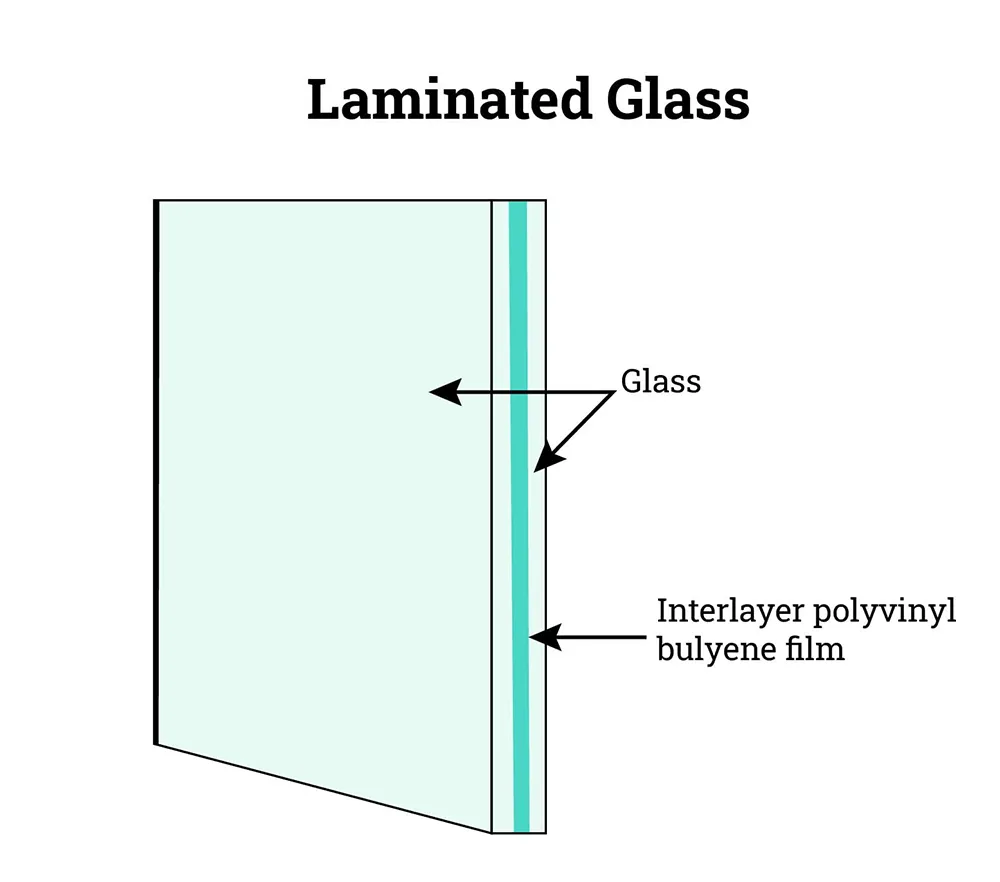
A laminated pane sandwiches a plastic interlayer, typically PVB or the stiffer SGP, between two sheets of glass. The interlayer acts as a damper: it converts vibration into a small amount of heat instead of transmitting it. That damping behavior, not the added thickness, is why a 6.4 mm laminated pane routinely outperforms an 8 or 10 mm monolithic pane of similar mass at the frequencies that matter.
Lamination also brings security and UV benefits, since the interlayer holds glass fragments in place on breakage and blocks most UV transmission. For a project already paying for impact or security glass, the acoustic benefit comes at no extra cost.
Asymmetry and cavity width in insulating units
In a double-glazed unit, two identical panes resonate at the same frequency and produce a coincidence dip that lets that band through. Making the panes different thicknesses moves the resonances apart. A wider cavity helps at low frequencies, but past roughly 100 mm the improvement flattens and structural depth becomes the constraint. Filling the cavity with argon or krypton adds a little; the dominant variables are mass, asymmetry and damping.
The frame and seals do half the work
A window is a system. Aluminum frames need internal damping and multi-chamber profiles to avoid becoming a flanking path. Gaskets should be continuous, compression-set rather than sliding, and doubled or tripled on operable units. Hardware penetrations need sealing. And the perimeter joint between frame and wall is where most real-world acoustic performance is lost: a 2 mm gap running the length of a frame can negate the entire glazing upgrade.
A selection path that works
- Measure the source. Note whether the dominant noise is traffic, rail, aircraft, mechanical equipment or neighbors, and when it peaks. Low-frequency sources change the specification.
- Set a target in decibels at the interior, not a product rating. A bedroom facing a busy road typically wants 30 to 35 dBA at night with windows closed.
- Choose the assembly, not the glass. Specify laminated glass of asymmetric build, a frame with a thermal break and multi-chamber profile, and a stated gasket arrangement.
- Require an installation detail. Continuous backing rod, acoustic sealant on both faces of the perimeter joint, and no unsealed penetrations. Then inspect it.
- Verify after handover. A one-night sound level reading with a phone app is crude but catches the failures that matter.
Be skeptical of any acoustic window claim that arrives without the glass make-up, the frame series, the tested rating and the test standard. Those four items are the entire specification. If you send us a noise problem and the site conditions, we will propose an assembly and state the rating we expect it to achieve, with the test reference behind it.
Need this checked against your project?
Send us your drawings or the code requirement — our engineers reply within 12 hours.