
What a New Wooden Front Door Costs
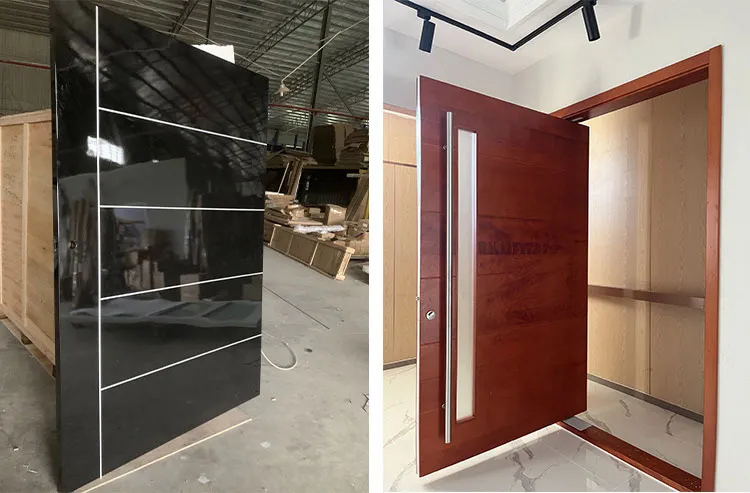
Wood is the material buyers ask for most often at the entrance, and the material most often mispriced in conversation. A stock slab and a custom entrance door can both be described as solid wood and differ by a factor of five, because the leaf is only part of what you are buying.
The five variables
- Leaf construction. A solid timber leaf, an engineered core with a timber face, and a hollow core with a veneer are three different products at three price levels, and the engineered core is usually the most dimensionally stable of the three.
- Species and grade. Oak, mahogany, walnut and teak price very differently, and clear grade costs more than a grade that permits knots and colour variation.
- Size and configuration. A single leaf at a standard size is the baseline. Adding sidelights, a transom, or widening beyond about 1,000 mm adds material, hardware and structural reinforcement.
- Hardware and security. A multipoint lock, a reinforced strike, a threshold with a thermal break and a quality cylinder can add a meaningful share to the total, and they are the parts that determine how the door performs in service.
- Finish and protection. A factory-applied finish with a defined maintenance cycle costs more up front and less over ten years than a site-applied coating that needs redoing every three.
Rough ranges
In the North American market, stock wooden entrance slabs sit in the low hundreds of dollars, a mid-range prehung wooden door with standard hardware typically lands in the high hundreds to low thousands, and a custom entrance with sidelights, premium species and a multipoint lock runs into the several thousands. The spread is real, and it reflects construction and hardware rather than brand.
Treat any figure as a planning number and not a quote. The same species and size can move by hundreds of dollars on hardware, finish and glazing alone.
Where the money is well spent
Three items repay their cost on an entrance door: the frame and its anchorage, the lock and strike, and the sill. These decide whether the door closes properly in year ten, whether it can be forced, and whether water reaches the bottom rail. Owners routinely spend the budget on the visible panel and discover that the frame was the problem.
Wood against the alternatives
Wood is repairable and warm, and it is the most forgiving material to fit into an existing opening. It also moves with humidity, and an unsheltered west-facing entrance will need refinishing on a shorter cycle than a sheltered one. Steel and thermally broken aluminum cost more or less depending on the specification, need less maintenance, and take large glazed panels more easily. On an exposed elevation with no canopy, the maintenance cycle of wood is the variable that should drive the decision.
What to send for a real number
Give us the opening width and height, the wall construction, whether sidelights are wanted, the species or finish direction, and the exposure. With those five we can return a specification and a price rather than a range, and state what the maintenance cycle will be for that location.
Need this checked against your project?
Send us your drawings or the code requirement — our engineers reply within 12 hours.