
Floor Hinge Installation: Step-by-Step Procedure
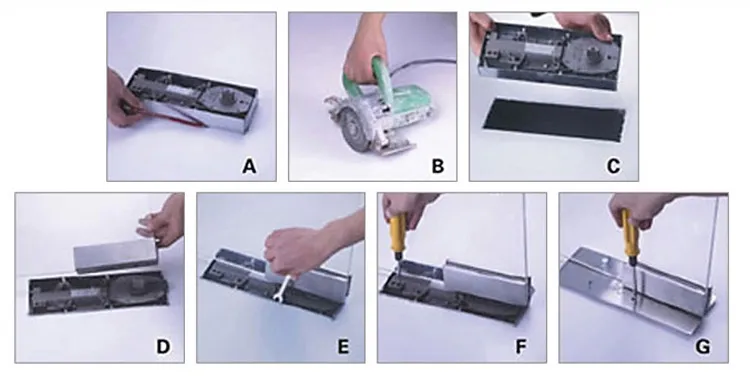
A floor hinge, sometimes called a floor spring, does three jobs: it carries the door weight, it defines the pivot axis, and it controls the closing speed. All three depend on the box being set accurately in the slab, which is why the installation precision of this component has a disproportionate effect on its service life.
Setting out
Establish the pivot axis first. Draw a line so that the centre of the floor hinge spindle coincides with the centre of the door's top pivot or clip. Both ends of the axis must be on the same vertical line; if the top pivot and the floor hinge are offset, the door will hang at an angle and the hinge will be loaded in a direction it was not designed for.
Casting the box in
Form the recess to the manufacturer's template and to the actual hinge body, not to a nominal size. The box should be a close fit in the recess, with no play and no forcing. Set the box level in both directions and confirm the top plate will finish flush with the finished floor level, taking the floor build-up into account. On a screeded floor this means setting the box before the screed, and protecting it during the pour.
Aligning and adjusting
- Place the hinge in the recess and check it is straight in both axes.
- Adjust the setting screws in the three adjustment directions until the door leaf hangs vertically, with the leaf edge parallel to the frame or the adjacent glass.
- Check that the top pivot spindle and the floor hinge spindle are coaxial by rotating the door through its full arc and observing any rise or bind.
- Set the closing speed and the latching speed with the adjustment valves, and confirm the door returns to the closed position from about 70 degrees of opening.
Finishing
Fit the decorative cover only after the adjustments are final, since the cover conceals the adjustment screws. Confirm the door does not rub the floor through its swing, and that the floor finish around the box is sealed so cleaning water cannot enter the recess.
Common failure causes
- Recess oversized, so the box moves under load and the door drops out of alignment.
- Box set out of level, so the door swings open or closed on its own and the internal valve cannot compensate.
- Top pivot and floor hinge not coaxial, which loads the spindle sideways and shortens seal life.
- Water ingress through an unsealed recess, which is the most common cause of a seized hinge in wet areas.
If you are detailing a glass pivot door, send the leaf weight and dimensions. We will confirm the hinge class and the recess template before the slab is poured, because after the pour the options narrow considerably.
Need this checked against your project?
Send us your drawings or the code requirement — our engineers reply within 12 hours.