
Installing Aluminum and Steel Products in Qatar: A Technical Guide
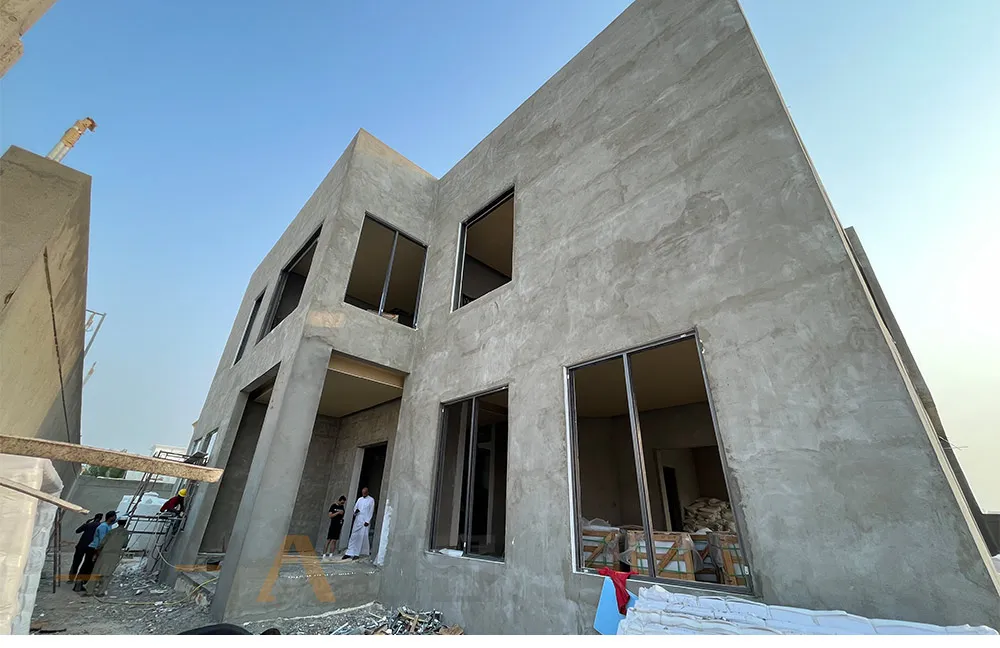
Between 10 and 20 July our technical team was on site in Qatar, supporting a residential project with the installation of aluminum windows, aluminum doors, steel doors and shade canopies. The project is a useful case study because the climate in the Gulf rejects several assumptions that hold in Europe or North America.
Start with the climate, not the drawing
Three conditions drive the specification. Surface temperatures in direct sun are high enough to affect sealant cure and to make handling during the middle of the day impractical. Wind carries sand, which abrades coated surfaces and finds every unsealed joint. And the coastal atmosphere is saline, which makes fastener selection a corrosion decision rather than a strength decision.
The practical consequences: work sequenced to avoid the hottest hours, sealant applied to prepared and dust-free surfaces with the correct primer, and stainless fixings throughout, with isolation between dissimilar metals at every connection.
Materials and surface preparation
We advised marine-grade aluminum for the window and door systems, with a finish specified for the exposure rather than the standard architectural coating. Surface preparation before sealing matters more here than in a temperate climate: dust on the substrate prevents adhesion, and an adhesion failure in a sand-laden environment becomes a water path within one season.
Installation sequence we advised
- Deliver and store by zone. On a large residential project, goods batched by location rather than by product type, so the installation team is not opening crates for building C while working on building A.
- Set and align frames with the same three-point verification used anywhere else, but check the opening first. Masonry tolerances on site are wider than the drawing assumes.
- Anchor steel doors into the structural opening with attention to the frame, not only the leaf. Security in a steel door is decided by the frame anchorage and the strike reinforcement.
- Seal in two stages, allowing the first application to cure before the second, because a single heavy application skins over and traps solvent.
- Install canopies last, and design them for wind uplift rather than only for shade. A canopy that lifts in a gust becomes a hazard and takes the fixings with it.
Canopies are part of the fenestration scope
On a west-facing elevation in the Gulf, external shading is not an amenity, it is what makes the glazing specification achievable. If the canopy is designed separately from the window, the shade line and the frame depth rarely agree, and the shading calculation in the energy model does not match the building. Our advice on this project was to detail the canopy with the window, including the fixing back to structure and the wind resistance requirement.
We provide on-site technical support for projects where the installation detail is unfamiliar to the local team. If you are building in a hot or coastal climate and want the fixing and sealing schedule reviewed before installation starts, send the section details.
Need this checked against your project?
Send us your drawings or the code requirement — our engineers reply within 12 hours.