
California Title 24: What It Requires of Your Windows
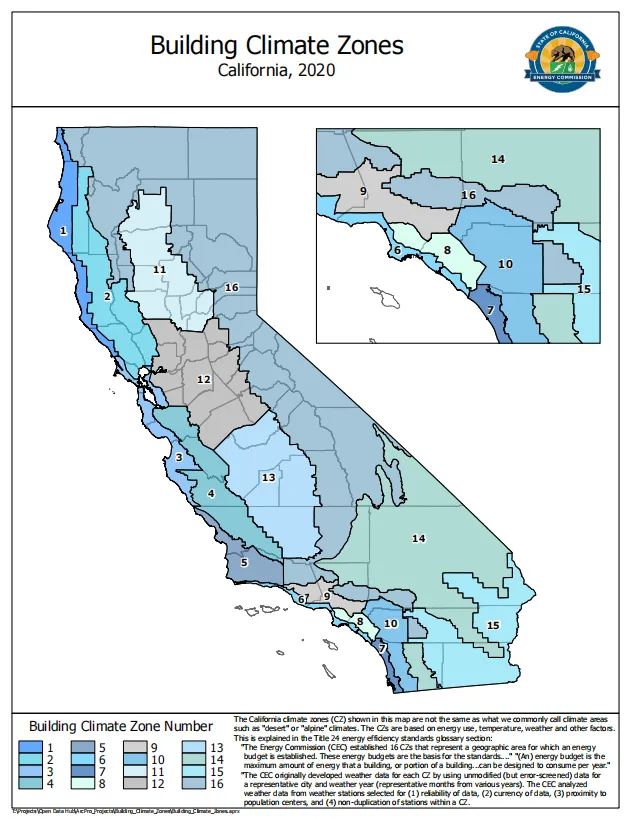
Title 24, Part 6 is California's building energy efficiency standard. For windows and doors it does three things: it sets performance limits that vary by climate zone, it requires certified and labeled products, and it makes the installer responsible for the envelope details around the opening. Buyers who treat it as a single U-factor number usually end up replacing glass or arguing with an inspector.
Three numbers, one label
U-factor measures heat flow through the whole assembly, frame included. Lower is better, and it is the number that drives most compliance tables. Solar Heat Gain Coefficient (SHGC) measures how much solar radiation the assembly admits; in cooling-dominated zones a low SHGC matters more than a low U-factor. Visible Transmittance (VT) measures daylight, and it is a design choice rather than a compliance lever, though it trades directly against SHGC.
All three are reported on the NFRC label affixed to the product. A label stating generic values for a product family is not sufficient; the label must correspond to the assembly as manufactured, meaning the same frame, spacer, glass make-up and gas fill.
Climate zone changes the target
California is divided into 16 climate zones, and the prescriptive tables assign different fenestration limits to each, further split by product type and by whether the project is residential or nonresidential. Coastal Los Angeles, inland Riverside and mountain zones do not share a single target. In the colder zones the binding constraint is usually U-factor; in the hot inland valleys it is SHGC.
This is why a supplier who quotes one glass build for the whole state is telling you they have not read the tables. Ask which climate zone the package is being designed for, and ask for the U-factor and SHGC of the specific assembly, not of the glazing alone.
Glass packages that get there
Two configurations cover most California residential work:
- 6 mm glass + 12 mm airspace + 6 mm glass, dual Low-E coating, argon fill. The standard answer for coastal and mixed zones, and the one we ship most often for Los Angeles and San Francisco area projects.
- 5 mm + 20 mm airspace + 5 mm, single Low-E, air or argon. The lower-cost route where the climate zone allows it and the SHGC target is not aggressive.
The airspace number matters as much as the coating. A wider cavity improves U-factor up to the point where convection inside the cavity starts to work against you; beyond roughly 20 mm the gain flattens and then reverses. Warm-edge spacers are worth the small premium in cold zones because they keep the frame edge above the dew point, which is where condensation complaints originate.
Where projects actually fail inspection
- No label, or a label that does not match the installed assembly. This is the single most common finding, and it is entirely avoidable.
- Replacement windows specified as new construction. Alteration rules differ, and a product certified for one path may not satisfy the other.
- Wrong zone assumption. A package designed for CZ 6 installed in CZ 14 will miss on SHGC.
- Air sealing and flashing left to the installer with no detail. The assembly can pass on paper and still fail a blower door test.
What to put in the specification
Name the climate zone, the prescriptive or performance compliance path, the required U-factor and SHGC for each product type, the NFRC certified product directory reference, and the label requirement. Add a line requiring the supplier to provide the certificate of compliance documentation package at shipment. Those five items remove almost all of the ambiguity an inspector can create.
If you are assembling a California package and want the U-factor, SHGC and VT for a specific frame and glass combination confirmed before you submit, send the schedule over. We will return the numbers per line item.
Need this checked against your project?
Send us your drawings or the code requirement — our engineers reply within 12 hours.