
Aluminum Prices and Window Costs: How the Metal Moves the Price
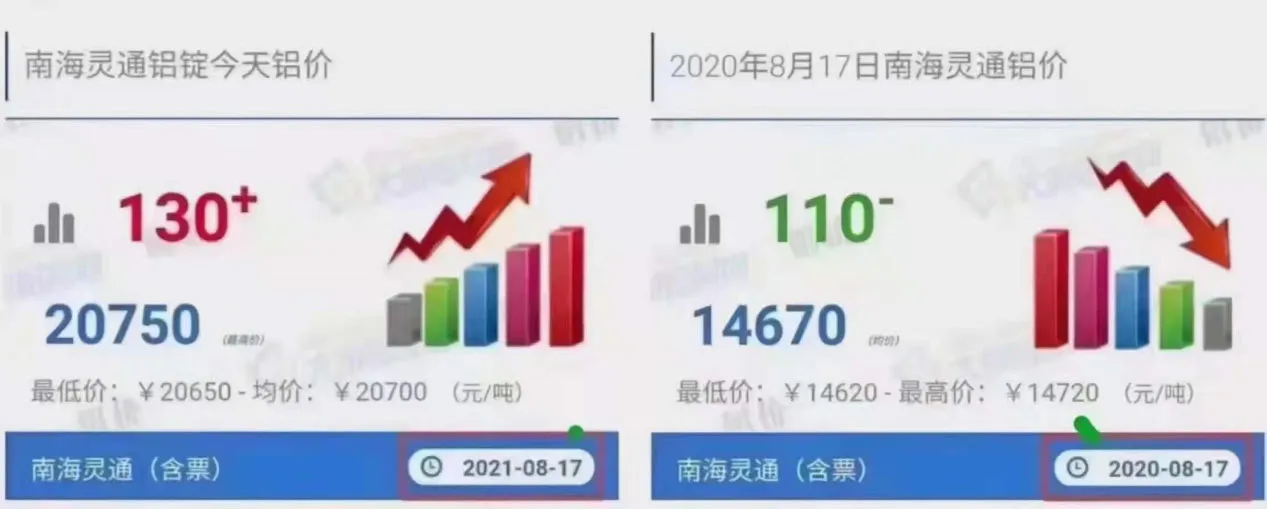
Buyers watch the aluminum index and expect the window quote to follow it one for one. It does not, and the reason is arithmetic. Aluminum is a large share of a window by weight and a smaller share by value, because everything else in the assembly costs money too.
The move that started this question
From 17 August 2020 to 17 August 2021 the aluminum alloy reference price rose from 14,670 RMB per ton to 20,750 RMB per ton, an increase of roughly 41 percent. Anyone quoting windows across that period had to reprice, and anyone buying had to understand why the increase in the finished product was smaller than the increase in the metal.
Why the finished price moves less
A thermally broken aluminum window uses on the order of 10 kg of aluminum per square meter of product. At a 6,000 RMB per ton move, that is about 60 RMB per square meter of window affected by the metal alone. If the finished unit price is several hundred RMB per square meter, the metal accounts for a fraction of the total, and the rest of the cost stack, glass, hardware, seals, fabrication, packing and freight, is untouched by the ingot index.
This is why a 41 percent metal move typically lands as a single-digit to low-double-digit percentage change in a finished window price. Material indices are a leading signal, not a price list.
How contracts usually handle it
Three mechanisms appear in commercial agreements:
- Fixed price with a validity window. The simplest and the most common for project work. It transfers the risk to the supplier for the stated period, and suppliers price that risk.
- Index-linked adjustment against a named reference and a fixed reference date. Common on larger contracts and on framework agreements. It is transparent and it requires both parties to accept the published index.
- Tolerance band with renegotiation beyond it. The ingot element is adjusted only when the index moves outside an agreed band, often plus or minus 10 percent. This removes the noise of small fluctuations from the paperwork.
The cost of each mechanism is different and the choice depends on how long the project runs. A three-month order should be fixed. A two-year frame agreement should be indexed.
Where else the cost moves
In the same period that aluminum moved, glass and freight moved further and faster than the metal, and both are larger swing factors per project. Glass supply tightened, container rates multiplied on some lanes, and the effective change in landed cost was driven more by the box than by the billet. Fixating on the aluminum index while ignoring the freight quote is a common analytical error.
What to ask for in a quote
- The reference date and the validity period for the price.
- The aluminum content per square meter assumed in the build-up, in kg.
- Whether the price is ex-works or includes freight, and which freight basis.
- The glass make-up and the coating specified, since a coating change moves the price more than a modest metal move.
If you want a current price file that states its reference date and validity window, and shows the aluminum content assumed per system, ask us and we will send it with the build-up rather than a single number.
Need this checked against your project?
Send us your drawings or the code requirement — our engineers reply within 12 hours.